Saturday, 28 May 2011

4 Review


‘The possibility of becoming the same as everyone else, not only in my behaviour, but in my inner structure would make me unable to feel real things, and would formalise everything – this is of such great concern to me that the film turned out to be partially about this. It’s about different-sameness.’ So says the director, Ilya Khrzahnovsky, on 4 (2005), a strange film about the odd concept of ‘different-sameness’, although even the DVD blurb is big enough to admit ‘it’s quite clear that something is going on – even if we don’t know what’.   

The film opens with prostitute Marina (Marina Vovchenko), meat merchant Oleg (Yuri Laguta) and piano tuner Volodya (Sergey Shnurov) randomly meeting in a bar, only to each begin constructing alternate identities for themselves. Marina passes herself off as a marketing manager for a new Japanese gizmo, Oleg pretends to work for the president (albeit only supplying him with bottled water) and Volodya claims to work on the secretive cloning operation that has worked successfully underground in Russia for years.

This first hour of the film is the strongest, as each lie slowly comes back in some way to haunt the characters, some even finding their actual lives becoming just as fictional as the fibs told in the bar. Constantly filmed in interesting ways with a brilliantly disgusting sound design, 4 (for it’s 1st half at least) provides an interesting comment on the idea that our lives run smoothly thanks to the lies we tell. These characters seem to share Khrzahnovsky’s fear of becoming the same as everyone else and so invent these alternative lifestyles that, for one conversation at least, propel them out of the drudgery of their real lives and into important roles in society.

I have never been to Russia and thanks to the images seen in 4, I don’t think I ever really want to. Stray dogs roam the streets and can be found in almost every frame of the film set outside. Huge bulldozers and other heavy machinery clog the atmosphere with smoke. The people in the film make the faces of Fellini look desirable as Khrzahnovsky appears to have cast those with only, shall we say, unusually put together faces; all helping to cast Russia in a delightfully nightmarish glow.

And yet, despite the undeniably bleak landscapes and communities who look older than they probably are, the film is full of darkly comic moments. One scene in which two old ladies pull, tug and slap their own bare breasts is a sure-fire laugh or cry moment, depending on your tolerance for 75-year old stretch marks.

The film’s lack of any real point does begin to outstay its welcome when Marina goes to a funeral full of old women who make dolls from chewed up pieces of bread but despite this, 4 is ultimately an interesting, visually arresting, albeit pointless film that raises some interesting questions about the inconvenience that is truth.

Here’s the opening minute of the film. It very much starts as it means to go on so this is a fairly decent test to see if you’ll be able to stomach this kind of inventive but seemingly meaningless action. http://www.youtube.com/watch?v=7FcUyGAapjg&feature=player_embedded

Sunday, 1 May 2011

Insidious Review


Just when you thought 2011 was shaping up to be a bit of a poor year for horror (The Rite, The Roommate and Justin Bieber: Never Say Never spring to mind) along comes Insidious, the new film from Saw’s James Wan to provide a some long overdue cinema scares.

The film sees Renai (Rose Byrne) and Josh Lambert (Patrick Wilson) move into a nice, big new house with their three kids. After some small, but severely strange goings on, their son, Dalton (Ty Simpkins), falls into a coma and triggers the start of some seriously creepy activity in the house.

Horror films seem to be the easiest to deem good or bad. Did it scare you? If so, it’s good, if not, then bad. Insidious scared me several times. The first hour of the film contains more than enough jumps, scares and subtly terrifying moments to heartily recommend it to both horror fans and anyone looking for a few sleepless nights.

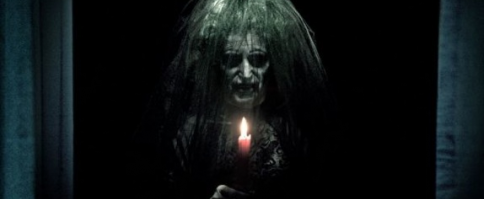
There are nasty images that linger in the mind, figures that invade the screen from every, unexpected angle and an opening sequence that, although brief, was ingrained in my mind long after the credits stop rolling. (Largely because at the end of the credits, the opening, ghoulish image is seen again).

In these kinds of films, particular moments and sequences stand out. Whistling shadows in M (1931), a ball going down the stairs in The Changeling (1980), THAT bit in Inside (2007) the flashing face in The House of the Devil (2009), the woman who lives downstairs getting some air in Martyrs (2008), take your pick from The Exorcist (1973). Thankfully, Insidious has one of these stand out moments that involves dancing and ‘Tiptoe Through The Tulips’ by Tiny Tim; one of the most effective songs used in a horror film in a long time. http://www.youtube.com/watch?v=K6qDOprU-Ps. Have a listen and try your very best to sleep with the lights off. Horrible.

Despite the scares, the characters seemed difficult to care about, but then again, horror is a bit of a selfish genre. Its not about them, it’s about you. You need to be scared. You need to look through your fingers. You need to shit your pants. If the characters strike a chord, it’s generally a bonus.

The film does stumble in its last twenty minutes, leaving the corridors of the haunted house and dipping into fantasy; a move that contained some scary moments, but generally stilted the tension that went before it which is a shame as had it kept up the atmospherics of its first hour, Insidious could have been a modern gem.

As it is, Insidious won’t win any prizes for originality, but despite losing its way in the second half, has more scares in it than anything seen in a while and with some truly memorable sequences, jumps galore and disturbing images that I’m finding hard to shake off, the first hour and a bit of Insidious is brilliantly, terrifying stuff. All together now: Tiptoe by the window, that is where I’ll be, come tiptoe through the tulips with meeeeeeeeee.

Sunday, 24 April 2011

Mary and Max Review


Mary and Max (2009), written and designed by Adam Elliot, is one of the greatest animations I think I have ever seen. It’s both funny and sad, and like Elliot’s Oscar winning short film ‘Harvie Krumpet’, manages to comment and highlight just what it means to be alive, all in just 90 minutes.

Mary Daisy Dinkle (voiced in her youth by Bethany Whitmore and Toni Collette in adulthood) is a girl living in Australia in the mid-70s with a birthmark on her face the colour of poo and only one friend in the world; a rooster named Ethel. One day she discovers a Manhattan phonebook and decides to write to a random name, hoping they will have the answers to the many questions troubling her. That random name is Max Jerry Horovitz (Philip Seymour Hoffman), a lonely man who spends his days attending over-eaters anonymous meetings and having panic attacks. Thus, an unlikely friendship is born.

The film manages to touch upon issues of bullying, love and loneliness through the pen-pal’s exchanges as well as indulging in stranger topics including Mary’s favourite words, Max’s favourite facts and their shared love of chocolate and TV show The Noblets.

Elliot manages to achieve both a sweet tone, largely thanks to the humorous narration by Barry Humphries, as well as delving into the darker side of life. Alongside an exploration of Asperger’s Syndrome, the film contains one of the most simple, unexpected and shocking moments that I have seen in a film in a long, long time.

As we drift between the dusty orange landscapes of Mary’s Oz and the gloomy shades of grey in Max’s New York, Mary and Max evolves into a truly life-affirming picture about the importance of friendship and left me wishing I had a pen-pal like Mary or Max, if only so that I could receive a chocolate Cherry Ripe and a list of favourite words that included banana, ointment and testicle. So if you’re not engaged in life-changing pen-pal relationship, and even if you are, do yourself a favour and watch Mary and Max, a film that makes Wallace and Gromit look like something from a poor episode of The Noblets.

Here is a link to Elliot’s Oscar winning short, Harvie Krumpet. http://www.youtube.com/watch?v=ouyVS6HOFeo
If only we could all wait for a bus that never comes with as much verve as Harvie.

Monday, 28 March 2011

He Was A Quiet Man Review


Frank Cappello’s He Was A Quiet Man (2007) is a strange little movie. It flits between comedy, drama and tragedy, is filled with all kinds of strange special effects and features Christian Slater with a comb-over. Need I say more.

The story follows Bob Malconel (Slater), a quiet, disgruntled office employee who sits in his coffin of a cubicle with dreams of blowing the building and everyone in it, sky high. He brings a gun to work everyday in the hope that one day he’ll pluck up the courage and perform an office Columbine. As if work wasn’t bad enough, he shares his home with a talking goldfish who routinely chastises him for not having the guts to do away with his co-workers. Told you it was odd.

When one day, a colleague of Bob’s beats him at his own game and decides to shoot everyone in the office, Bob uses his gun for good and shoots the guy, becoming an instant hero. The downside is that the one girl in the office that Bob is in love with, Venessa (Elisha Cuthbert), survives the shooting, but loses all feeling from the neck down after being shot.

Thus, one strange romantic drama is born. Whilst the odd special effects are unsettling and distracting at first, the story soon overwhelms them and it is both the plot and Slater’s brilliantly pent up performance that makes the film work. One of the delights of the film is its twists, turns and general inventiveness. When after five minutes you’re introduced to a potty mouthed goldfish, you can pretty much forget about predicting the rest of the story.

As the relationship arc of the story blooms, the film starts to take a more serious turn and the film, despite the funny talking goldfish and William H. Macy’s role as the annoying CEO, is desperately sad and all the more involving for it. You can’t help but feel for Bob, despite his initial intentions, as he finally ‘gets’ the girl but under entirely different circumstances from what he could have ever imagined.

The film’s ending is bound to divide audiences. You can either see it as a cop-out, an ending which completely undermines the entirety of the film, or, as I did, find that it makes the story even more tragic and personal than a film with a talking goldfish should ever be expected to be.

Following in the footsteps of other ‘ordinary people on the edge’ titles that include the great Network (1976), Taxi Driver (1976) (1976 seemed to be a good year for people losing it on screen, Carrie and The Omen also came out this year so it wasn’t just exclusively adults) and Falling Down (1993), He Was A Quiet Man brings a rare sentimentality that these films often lack. Carried by Slater’s great performance and rounded off with a brutal ending, Cappello’s film may look a little ‘TV movie’, but leaves just as much an emotional kick as any great, big screen weepie.


*Just a side note, the film, as emotional as it was, did not reduce me to tears (and I don't think that was it's aim). I only mention this to get onto the subject at crying at films. As a prime example of masculinity (...), and not really a crier (although I did weep at the BFG, but that was out of fear), I can recommend the Korean film, Peppermint Candy (1999) by Chang-dong Lee. It’s an amazing film that would leave the cast of The Expendables a blubbering mess. I defy you not to at least get glassy eyes.

Saturday, 26 March 2011

Chopper Review


The real life star of Andrew Dominik’s Chopper (2000) is Mark Brandon ‘Chopper’ Read. One of Australia’s most notorious criminals and now, one of the country’s most successful authors. In one of his first film roles (and probably his best), Eric Bana plays Chopper as both a vicious, dangerous, nervous ball of violent energy, but also, quite a likeable guy. As Chopper himself states, ‘I’m just a bloody normal bloke. A normal bloke who likes a bit of torture.’

The film opens with Chopper watching himself on television in an interview and follows him through two jail terms and the period in between in which he roamed free. Bana plays him with enough charm and honesty that it becomes very difficult not to like him. He kills drug dealers, has a good relationship with the prison guards and later the cops and is serving jail time for attempting to bust his best friend out of jail. Aside from the occasional bit of torture, he’s a sweetheart.

But it is the spontaneous bursts of violence and aggression that shock both us and seemingly himself. Whether it be shooting someone for cash or beating his girlfriend after a tiff, Domink provides us with enough uncomfortable moments to ensure that we don’t leave the film with any sort of romanticised view. He can be a nasty piece of work when he wants to be.

And this provides the main point of interest in the film, a source of internal conflict that is clear for all to see. We see him offer a victim a cigarette after he stabs them and drive someone to a hospital so doctors can remove the bullet that he had just shot into them. 

That said, despite the flashes of violence, Chopper is a very funny film, mainly down to the fact that Chopper seems to be a very funny man and Domink uses this humour as a means of lowering our guard and letting the monster in. Eric Bana’s performance is outstanding and he manages to pour more uncontrollable aggression into Chopper than was ever seen in his role as Bruce Banner in Hulk.

We see to have a strange relationship with famous murderers put on screen. Whilst we wouldn’t like to get too close, they provide such entertaining and interesting figures. What I wouldn’t give for Chopper to arrive uninvited to Forks and make Twilight a little more watchable, giving both the audience and Bella more to think about. Wolf, vampire or witty Australian nutter? I know who I'd want her to choose.

Any fictional film based on a real life cannot help but force the question: is this what they are really like? Can Chopper really walk the line between comic and nutcase? Is he really that funny? Was he really that vicious? And the end of the day, does it matter? Chopper is constantly entertaining, shocking, funny and intriguing and on the subject of its authenticity, as he himself states in the film, ‘Never let the truth get in the way of a good yarn’. And what a yarn this is too.

For those who want to know more about the ‘real’ Chopper, the film Fat Belly Chopper…Unchopped (2009) is a documentary about and starring, the man himself.

Thursday, 17 February 2011

The Social Network Review


Facebook. Chances are it’s not far from a computer screen near you. Just checked it? Up on a tab? It has become an essential social tool for most, an obsession for some and is now the subject of David Fincher’s latest movie, a film that takes us back to the origins of the social network that changed the way we act for good. Or at least until something better, newer and shinier comes along.

The film, based on Ben Mezrich’s The Accidental Billionaires, scripted by Aaron Sorkin (A Few Good Men, The West Wing, Charlie Wilson’s War) and directed by David Fincher (Seven, Fight Club, The Curious Case of Benjamin Button) tells the story of how the socially inept Mark Zuckerberg (Jesse Eisenberg) came to a site that united millions and ensuing court cases that he faced from best friend Eduardo Saverin (the lycra bound future Spidey, Andrew Garfield) and techno rivals, the Winklevoss twins (both played by Armie Hammer). Nerds have never seemed so cool.

The Social Network arrives on DVD on the back of a wave of critical praise and awards. Taking Best Picture and Best Original Score at the Golden Globes and Best Director and Best Adapted Screenplay at both the Globes and the Bafta’s give an indication of where the films strengths lie.

Sorkin’s script does a fantastic job of being witty, hurtling along at breakneck speed as well as explaining the techno jargon in such a way that, whilst not dumbing it down, makes it entirely comprehendible to hacker virgins everywhere. Sorkin takes us from dorm room to courtroom in the blink of an eye and the screenplay absolutely burns through its two hour running time in what feels like no time at all.

Reliably, Fincher gives The Social Network the all the style and verve of Fight Club but with the crisp polish of Button and as always gets great performances from his actors. (Remember this is the man who managed to get us in a room with Jodie Foster for two hours without the need for us to go all Buffalo Bill on her creeping in).

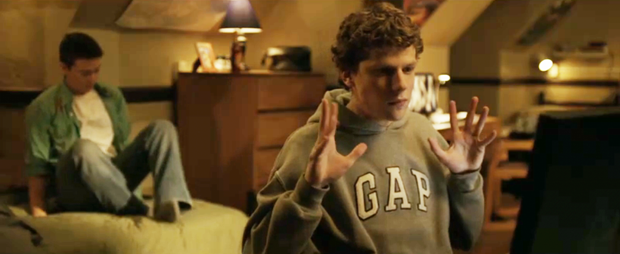
Jesse Eisenberg portrays Zuckerberg in a way that our opinions can’t help but shift throughout. He’s geeky, clearly socially inept and has issues with loyalty. Often rude to girls and even ruder to them once they highlight his flaws. On this evidence, it’s a struggle to like the guy. But his constant wit, hilarious put downs and a general aura that casts him as both the smartest and sharpest guy in the room make him someone you’d like to be friends with. On Facebook at least.

Those surrounding Eisenberg are equally impressive. Garfield gets our sympathy as the best friend left hung out to dry. Hammer gives the twins (or as Zuckerberg refers to them  – The Winklevei) a jock-like arrogance and stupidity that leaves them targets for Zuckerberg in court and we can’t help but struggle to side with them, despite what clearly appears to be a somewhat unfair situation. Even Justin Timberlake does well as Napster co-founder Sean Parker, one of those characters who almost everyone in the audience would quite happily punch in the face; he musters up about as much likeability as The Green Mile’s Percy Wetmore.

Despite the assured direction and impressive script, the films success lies in the simple reason that its ideas and merely what is on show is now a universal interest. It connects with almost anyone who watches it. As much as I loved Fight Club, I just can’t see myself up against a bare-chested Brad Pitt. (Female readers I’m sure are just trembling at the very image). The reason Annie Hall is my favourite movie of all time is that when I first watched it, I was Alvy Singer. In a similar fashion, The Social Network taps into ideas and experiences that we can all relate. On the surface, using Facebook. Blogging.  But also ideas around friendship, the frailty of friendships, jealousy, jealousy between friends, wanting success and of course, being a nerd.

Facebook, of course, has plenty of enemies. So too, it appears, did Mark Zuckerberg. But in years to come, if it is seen as the general consensus that Facebook did more harm than good. Brought civilisation back thousands of years. Created generations that communicated with each other only via a virtual wall. Then at least, we can say, that two pretty amazing films were born out of it.
(Oh, the other being Catfish)

The Social Network. Billy Langsworthy ‘likes’ this.

Tuesday, 15 February 2011

True Grit Review


I should say from the outset that I am a huge fan of the Coen Brothers. They very rarely do much wrong in my eyes. Blood Simple. Raising Arizona. Barton Fink. Fargo. The Big Lebowski. The Man Who Wasn’t There. No Country For Old Men. A Serious Man. All favourites of mine. So it was with a great amount of anticipation that I saw their latest effort, True Grit.

The film is based on Charles Portis’ 1968 novel rather than the 1969 film version that gave John Wayne his only Oscar for his portrayal as Rooster Cogburn. Narrated by an adult Mattie Ross (Elizabeth Marvel), the film takes place when she was a stubborn fourteen year old (newcomer Hailee Steinfeld) and out for justice after her father is murdered by one of his hired hands Tom Chany (Josh Brolin). She chooses the most ruthless Marshall in town, Rooster Cogburn (Jeff Bridges) and Texas Ranger LaBoeuf (Matt Damon) to apprehend Chany and the unlikely trio set off on their journey.

The film is the one of the Coen Brothers more conventional efforts to date, but Coen-esque moments are still present, in both a scene where a man is hung exceptionally high in a tree and the exceptionally surreal moment where it seems a bear is riding a horse towards the trio.

Despite being a more straight effort, the quality is as high as ever. Cinematographer Roger Deakins (now on his 11th Coen Brother movie) delivers immense image after immense image, ranging from the busy, sweeping locations of the opening town scenes to the breathtaking, desolate locations that really convey a sense that the three characters are pursuing a man hiding in a harsh, unforgiving landscape.

Jeff Bridges manages to put his own stamp of the role made famous by Wayne and his Cogburn shifts from being a useless drunk to character you can’t help but violently cheer for come the films final third. It’s also a somewhat brave turn from Jeff Bridges considering the mumbling nature of his performance, but this, if anything, adds to what is an authentic, believable portrayal of both inebriated and the heroic Cogburn. Credit also to Matt Damon, whose LeBoef manages to come across likable despite clearly being an oaf in spurs.

Hailee Steinfeld puts in one of the most impressive debuts of recent times with her portrayal of Mattie and manages to hold her own against the powerhouse performance of Bridges. She gets all the best lines and her sarcastic snipes at her co-stars as well as her stubborn attitude in getting the journey going help to suggest that it is indeed the fourteen year old girl that possesses the grit of the title.

Thoroughly entertaining, often funny and always a pleasure to look at, the film contains an ending that packs a somewhat unexpected emotional punch that leaves True Grit as one of the Coens more conventional crowd pleasers, but also, one of the very best films of their career.

(Will Self has written a retrospective look at the films of the Coens that is sure to get under the skin of any fan of the Brothers. Have a look. http://www.guardian.co.uk/film/2011/feb/11/will-self-coen-brothers)