Monday, 28 March 2011

He Was A Quiet Man Review


Frank Cappello’s He Was A Quiet Man (2007) is a strange little movie. It flits between comedy, drama and tragedy, is filled with all kinds of strange special effects and features Christian Slater with a comb-over. Need I say more.

The story follows Bob Malconel (Slater), a quiet, disgruntled office employee who sits in his coffin of a cubicle with dreams of blowing the building and everyone in it, sky high. He brings a gun to work everyday in the hope that one day he’ll pluck up the courage and perform an office Columbine. As if work wasn’t bad enough, he shares his home with a talking goldfish who routinely chastises him for not having the guts to do away with his co-workers. Told you it was odd.

When one day, a colleague of Bob’s beats him at his own game and decides to shoot everyone in the office, Bob uses his gun for good and shoots the guy, becoming an instant hero. The downside is that the one girl in the office that Bob is in love with, Venessa (Elisha Cuthbert), survives the shooting, but loses all feeling from the neck down after being shot.

Thus, one strange romantic drama is born. Whilst the odd special effects are unsettling and distracting at first, the story soon overwhelms them and it is both the plot and Slater’s brilliantly pent up performance that makes the film work. One of the delights of the film is its twists, turns and general inventiveness. When after five minutes you’re introduced to a potty mouthed goldfish, you can pretty much forget about predicting the rest of the story.

As the relationship arc of the story blooms, the film starts to take a more serious turn and the film, despite the funny talking goldfish and William H. Macy’s role as the annoying CEO, is desperately sad and all the more involving for it. You can’t help but feel for Bob, despite his initial intentions, as he finally ‘gets’ the girl but under entirely different circumstances from what he could have ever imagined.

The film’s ending is bound to divide audiences. You can either see it as a cop-out, an ending which completely undermines the entirety of the film, or, as I did, find that it makes the story even more tragic and personal than a film with a talking goldfish should ever be expected to be.

Following in the footsteps of other ‘ordinary people on the edge’ titles that include the great Network (1976), Taxi Driver (1976) (1976 seemed to be a good year for people losing it on screen, Carrie and The Omen also came out this year so it wasn’t just exclusively adults) and Falling Down (1993), He Was A Quiet Man brings a rare sentimentality that these films often lack. Carried by Slater’s great performance and rounded off with a brutal ending, Cappello’s film may look a little ‘TV movie’, but leaves just as much an emotional kick as any great, big screen weepie.


*Just a side note, the film, as emotional as it was, did not reduce me to tears (and I don't think that was it's aim). I only mention this to get onto the subject at crying at films. As a prime example of masculinity (...), and not really a crier (although I did weep at the BFG, but that was out of fear), I can recommend the Korean film, Peppermint Candy (1999) by Chang-dong Lee. It’s an amazing film that would leave the cast of The Expendables a blubbering mess. I defy you not to at least get glassy eyes.

Saturday, 26 March 2011

Chopper Review


The real life star of Andrew Dominik’s Chopper (2000) is Mark Brandon ‘Chopper’ Read. One of Australia’s most notorious criminals and now, one of the country’s most successful authors. In one of his first film roles (and probably his best), Eric Bana plays Chopper as both a vicious, dangerous, nervous ball of violent energy, but also, quite a likeable guy. As Chopper himself states, ‘I’m just a bloody normal bloke. A normal bloke who likes a bit of torture.’

The film opens with Chopper watching himself on television in an interview and follows him through two jail terms and the period in between in which he roamed free. Bana plays him with enough charm and honesty that it becomes very difficult not to like him. He kills drug dealers, has a good relationship with the prison guards and later the cops and is serving jail time for attempting to bust his best friend out of jail. Aside from the occasional bit of torture, he’s a sweetheart.

But it is the spontaneous bursts of violence and aggression that shock both us and seemingly himself. Whether it be shooting someone for cash or beating his girlfriend after a tiff, Domink provides us with enough uncomfortable moments to ensure that we don’t leave the film with any sort of romanticised view. He can be a nasty piece of work when he wants to be.

And this provides the main point of interest in the film, a source of internal conflict that is clear for all to see. We see him offer a victim a cigarette after he stabs them and drive someone to a hospital so doctors can remove the bullet that he had just shot into them. 

That said, despite the flashes of violence, Chopper is a very funny film, mainly down to the fact that Chopper seems to be a very funny man and Domink uses this humour as a means of lowering our guard and letting the monster in. Eric Bana’s performance is outstanding and he manages to pour more uncontrollable aggression into Chopper than was ever seen in his role as Bruce Banner in Hulk.

We see to have a strange relationship with famous murderers put on screen. Whilst we wouldn’t like to get too close, they provide such entertaining and interesting figures. What I wouldn’t give for Chopper to arrive uninvited to Forks and make Twilight a little more watchable, giving both the audience and Bella more to think about. Wolf, vampire or witty Australian nutter? I know who I'd want her to choose.

Any fictional film based on a real life cannot help but force the question: is this what they are really like? Can Chopper really walk the line between comic and nutcase? Is he really that funny? Was he really that vicious? And the end of the day, does it matter? Chopper is constantly entertaining, shocking, funny and intriguing and on the subject of its authenticity, as he himself states in the film, ‘Never let the truth get in the way of a good yarn’. And what a yarn this is too.

For those who want to know more about the ‘real’ Chopper, the film Fat Belly Chopper…Unchopped (2009) is a documentary about and starring, the man himself.

Thursday, 17 February 2011

The Social Network Review


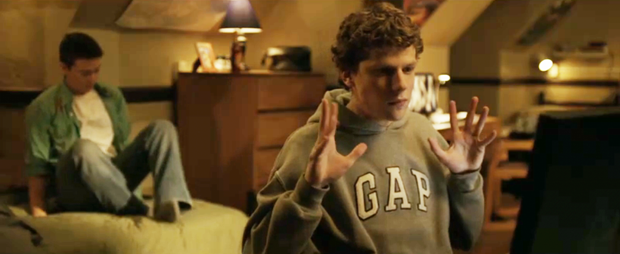
Facebook. Chances are it’s not far from a computer screen near you. Just checked it? Up on a tab? It has become an essential social tool for most, an obsession for some and is now the subject of David Fincher’s latest movie, a film that takes us back to the origins of the social network that changed the way we act for good. Or at least until something better, newer and shinier comes along.

The film, based on Ben Mezrich’s The Accidental Billionaires, scripted by Aaron Sorkin (A Few Good Men, The West Wing, Charlie Wilson’s War) and directed by David Fincher (Seven, Fight Club, The Curious Case of Benjamin Button) tells the story of how the socially inept Mark Zuckerberg (Jesse Eisenberg) came to a site that united millions and ensuing court cases that he faced from best friend Eduardo Saverin (the lycra bound future Spidey, Andrew Garfield) and techno rivals, the Winklevoss twins (both played by Armie Hammer). Nerds have never seemed so cool.

The Social Network arrives on DVD on the back of a wave of critical praise and awards. Taking Best Picture and Best Original Score at the Golden Globes and Best Director and Best Adapted Screenplay at both the Globes and the Bafta’s give an indication of where the films strengths lie.

Sorkin’s script does a fantastic job of being witty, hurtling along at breakneck speed as well as explaining the techno jargon in such a way that, whilst not dumbing it down, makes it entirely comprehendible to hacker virgins everywhere. Sorkin takes us from dorm room to courtroom in the blink of an eye and the screenplay absolutely burns through its two hour running time in what feels like no time at all.

Reliably, Fincher gives The Social Network the all the style and verve of Fight Club but with the crisp polish of Button and as always gets great performances from his actors. (Remember this is the man who managed to get us in a room with Jodie Foster for two hours without the need for us to go all Buffalo Bill on her creeping in).

Jesse Eisenberg portrays Zuckerberg in a way that our opinions can’t help but shift throughout. He’s geeky, clearly socially inept and has issues with loyalty. Often rude to girls and even ruder to them once they highlight his flaws. On this evidence, it’s a struggle to like the guy. But his constant wit, hilarious put downs and a general aura that casts him as both the smartest and sharpest guy in the room make him someone you’d like to be friends with. On Facebook at least.

Those surrounding Eisenberg are equally impressive. Garfield gets our sympathy as the best friend left hung out to dry. Hammer gives the twins (or as Zuckerberg refers to them  – The Winklevei) a jock-like arrogance and stupidity that leaves them targets for Zuckerberg in court and we can’t help but struggle to side with them, despite what clearly appears to be a somewhat unfair situation. Even Justin Timberlake does well as Napster co-founder Sean Parker, one of those characters who almost everyone in the audience would quite happily punch in the face; he musters up about as much likeability as The Green Mile’s Percy Wetmore.

Despite the assured direction and impressive script, the films success lies in the simple reason that its ideas and merely what is on show is now a universal interest. It connects with almost anyone who watches it. As much as I loved Fight Club, I just can’t see myself up against a bare-chested Brad Pitt. (Female readers I’m sure are just trembling at the very image). The reason Annie Hall is my favourite movie of all time is that when I first watched it, I was Alvy Singer. In a similar fashion, The Social Network taps into ideas and experiences that we can all relate. On the surface, using Facebook. Blogging.  But also ideas around friendship, the frailty of friendships, jealousy, jealousy between friends, wanting success and of course, being a nerd.

Facebook, of course, has plenty of enemies. So too, it appears, did Mark Zuckerberg. But in years to come, if it is seen as the general consensus that Facebook did more harm than good. Brought civilisation back thousands of years. Created generations that communicated with each other only via a virtual wall. Then at least, we can say, that two pretty amazing films were born out of it.
(Oh, the other being Catfish)

The Social Network. Billy Langsworthy ‘likes’ this.

Tuesday, 15 February 2011

True Grit Review


I should say from the outset that I am a huge fan of the Coen Brothers. They very rarely do much wrong in my eyes. Blood Simple. Raising Arizona. Barton Fink. Fargo. The Big Lebowski. The Man Who Wasn’t There. No Country For Old Men. A Serious Man. All favourites of mine. So it was with a great amount of anticipation that I saw their latest effort, True Grit.

The film is based on Charles Portis’ 1968 novel rather than the 1969 film version that gave John Wayne his only Oscar for his portrayal as Rooster Cogburn. Narrated by an adult Mattie Ross (Elizabeth Marvel), the film takes place when she was a stubborn fourteen year old (newcomer Hailee Steinfeld) and out for justice after her father is murdered by one of his hired hands Tom Chany (Josh Brolin). She chooses the most ruthless Marshall in town, Rooster Cogburn (Jeff Bridges) and Texas Ranger LaBoeuf (Matt Damon) to apprehend Chany and the unlikely trio set off on their journey.

The film is the one of the Coen Brothers more conventional efforts to date, but Coen-esque moments are still present, in both a scene where a man is hung exceptionally high in a tree and the exceptionally surreal moment where it seems a bear is riding a horse towards the trio.

Despite being a more straight effort, the quality is as high as ever. Cinematographer Roger Deakins (now on his 11th Coen Brother movie) delivers immense image after immense image, ranging from the busy, sweeping locations of the opening town scenes to the breathtaking, desolate locations that really convey a sense that the three characters are pursuing a man hiding in a harsh, unforgiving landscape.

Jeff Bridges manages to put his own stamp of the role made famous by Wayne and his Cogburn shifts from being a useless drunk to character you can’t help but violently cheer for come the films final third. It’s also a somewhat brave turn from Jeff Bridges considering the mumbling nature of his performance, but this, if anything, adds to what is an authentic, believable portrayal of both inebriated and the heroic Cogburn. Credit also to Matt Damon, whose LeBoef manages to come across likable despite clearly being an oaf in spurs.

Hailee Steinfeld puts in one of the most impressive debuts of recent times with her portrayal of Mattie and manages to hold her own against the powerhouse performance of Bridges. She gets all the best lines and her sarcastic snipes at her co-stars as well as her stubborn attitude in getting the journey going help to suggest that it is indeed the fourteen year old girl that possesses the grit of the title.

Thoroughly entertaining, often funny and always a pleasure to look at, the film contains an ending that packs a somewhat unexpected emotional punch that leaves True Grit as one of the Coens more conventional crowd pleasers, but also, one of the very best films of their career.

(Will Self has written a retrospective look at the films of the Coens that is sure to get under the skin of any fan of the Brothers. Have a look. http://www.guardian.co.uk/film/2011/feb/11/will-self-coen-brothers)

Yella Review


Christian Petzold’s 2007 film Yella is a thriller that follows a woman called Yella, played by Nina Hoss, trying to make it big in business after a traumatic episode with her obsessive ex-husband.

Yella has had enough of her life in the former East Germany. This may be due to living with her father. Or perhaps it’s down to her doing a job she’s fed up doing. Most likely is that she wants to escape the psychotic grip of her ex-husband Ben (Hinnerk Schonemann) who is stalking her.

After deciding upon leaving town and moving to Hanover for better job prospects, she, somewhat misguiding, takes a lift from Ben who says he wants to take her. He promises to behave. Behaving is clearly not on the agenda though, as Ben drives them both off a bridge into a river.  Although soaking, Yella escapes the sinking car, still makes her train and heads to Hanover where she meets Phillip (Devid Striesow), an executive at a private equity company who, despite subtly resembling Ben, takes Yella under his wing.

And so begins the film. And Yella’s new life in the cut-throat world of boardrooms. Petzold does not rely on flashy direction, quick editing or a best-selling soundtrack to draw viewers in; for an 87 minute movie it takes its time. And rightly so. The pacing of the film allows for moments of chilling atmospherics as Yella begins to hear and see an ever increasing pattern of sounds and motifs.

Wind brushing through trees and a strange underwater sound swells and seems to deafen only Yella in meetings with clients. A phantom crow caws whilst she sits in her hotel room. All the while, she continues to have visions of Ben. Has Yella lost her mind or are more supernatural forces in motion?

The film is intriguing throughout and drips moments of eeriness and possible revelation just at moments when the business jargon may start to feel heavy.

Yella appears to be making some sort of comment around financial and business differences between East and West Germany particular with the ever prominent red colour that seeps into the frame at any given moment. However, these (as they did on me) may be entirely lost on a non-German audience.

Now this might not sound all that thrilling; and in all honesty, it isn't. Yella is a film that you take at it's own pace and find things you want to find from it. Theres enough legroom in the plot and several blanks that are avaliable for you can choose to fill however you may wish (if indeed you can be bothered at all). Some may find it slow. I didn't. However this may be down to watching Julia beforehand, a film so slow that it would make watching paint dry something of an adrenaline rush.

Maybe I'm being a little harsh. Whilst the films business moments occasionally dragged, they did evoke rare moments of humour and the film’s ending only served to evoke curiosity. Yella is by no means faultless but is certain to be a film that you either find dull and frustrating or quietly engrossing and intriguing. I liked the film more upon reflection than I did watching it, and I suppose that pretty much tells you all you need to know.

Sunday, 13 February 2011

Julia Review


Since its premiere at the 2008 Berlin Film Festival, Erick Zonca’s Julia has earned high praise from critics and the public alike with renowned film critic Roger Ebert calling it ‘a nerve-wracking thriller with a twisty plot and startling realism’.

The film, based on John Cassavetes’ 1980 movie Gloria, is a character study come ‘thriller’ about Julia, an alcoholic played by Tilda Swinton, who spends her days and nights drinking herself from nightclub to nightclub, and bed to bed.

That is until she meets Elena (Kate Del Castillo), a fellow Alcoholics Anonymous member with a crazy glint her eye. Driven to madness by the loss of her son Tom (Aidan Gould) to the boy’s wealthy grand father, she asks Julia to help her kidnap him. Spotting an opportunity to squeeze more cash from the Elena shaped cash cow, Julia kidnaps the boy herself and holds them both to ransom.

The first half of the film meanders along, concerning itself with establishing Julia’s drinking and social problems whilst the second half involves the kidnap. The film is two hours twenty four minutes long. It feels closer to three.

Switching from the neon, drunken hazes of Julia’s nightlife to the desolate emptiness of the Mexican border, everything looks visually impressive (thanks to the Director of Photography Yorick Le Saux, whose previous work includes Francois Ozon’s fantastic Swimming Pool), but the film is so poorly paced that it seems to drag and drag and drag some more before limping to its sudden, unsatisfying conclusion.

Tilda Swinton is good in conveying the attitudes and swagger of a woman who we cannot be sure sees the boy as a child or merely a fleshy bag of cash. Likewise, everything in the film is played realistically and does not seep into melodrama or mindless action sequences. Even a helicopter chase is constructed via handheld cameras. It’s just the films pacing makes it difficult to care. You are fully aware that Swinton is having a good stab at it but the ‘it’ being stabbed is just not good enough.

The stand out scene in the movie is an attempt at the classic movie scenario where a character is required to collect illegal cash from a locker at an airport or station or any other location where every other member of the public looks suspiciously like an undercover cop. Unfortunately for Julia, a film needs more than one scene to live long in the memory and although the film picks up with the introduction of some troublesome Mexicans, its only twenty minutes of a much longer movie.

Tilda Swinton is a great actress (see I Am Love) but unfortunately Julia feels just as hung-over as it's title character for most of its running time. Still as slow as the movie is, it goes by like a flash compared to Swinton’s other foray into deathly slow paced cinema, Béla Tarr’s endurance testing The Man From London. Try both if you dare.


Sunday, 30 January 2011

127 Hours Review

127 Hours is one of those ‘what would I do?’ movies. Just as Buried prompted me to ask what I would do if buried alive and 7 Days forced me to question what I would do if I found my daughters killer and A Serbian Film made me think of what I would do with the 10 pounds that I had just wasted on buying the bloody film on DVD; Danny Boyle’s 127 Hours made me think what the hell would I do if fell down a crack in a canyon in Utah and was left alone, trapped with my arm crushed under a sizable rock.

The film is the true story of Aron Ralston (played by James Franco), who wrote of his ordeal in the book, ‘Between a Rock and a Hard Place’. Aron went off hiking, without telling anybody where he was going and fell down a deep, narrow crevice, got his arm trapped, stayed down there for more than 5 days before (and I’m sure everyone knows about this bit) he cuts his arm off.

Described by Boyle as “an action movie with a guy who can’t move”, 127 Hours contains far more thrills, action and emotion than you’d think could possibly be squeezed from Ralston’s lonesome situation.

Thanks to him bringing a camera along for the journey, we see Aron talking to his family through the lens and it gives him the change to externalise his inner thoughts and feelings, often in a humorous way.

From the visually frantic opening, Boyle sets up a film that is full of impressive montage moments that express elements of Ralston’s dire situation. Alongside Franco’s visibly cracked lips, we see a montage of adverts all demonstrating ‘thirst-quenchers’, recreating a feeling of thirst so intense that I even found my mouth drying up whilst watching.

We begin to truly get a sense of the world that Aron is left trapped in. A world visited by an eagle regularly. A world punctured by sunlight for a few hours a day. And in this world, Franco manages to portray a number of different sides to Ralston. We see his cocky, adventurous side plummet into a sort of a comic side that makes light of his struggle and finally a ruthlessly logical and matter of fact side that comes to terms with the fact that the arm needs to go.

And so we come to that arm. Most of the talk around the film surrounds the sequence where he cuts his arm off. It is grim and you do feel it but it’s not ‘faintworthy’ as has been claimed and it occupies only a few minutes of the film. It will prove to be a big loss if people don’t go to see the film due to squeamish concerns because the film, although obviously a key moment, is so much more than that.  

The film has an impressive score from A.R. Rahman, who previously worked with Boyle on Slumdog Millionaire, and one of the best soundtracks I’ve heard in a film for a while. Songs are included for a number of different purposes, some evoking emotion whilst others, like Bill Wither’s Lovely Day, raising a wry smile considering Ralston’s situation.

Boyle seems to be continuing a streak that now sees him the name behind favourites including Trainspotting, The Beach, 28 Days Later and Slumdog Millionaire; 127 Hours is up there with his best. Colourful, constantly entertaining and surprisingly affecting, 127 Hours is the most action packed film about a man on his own since, well…. Buried. [Insert arm related pun here]